What should a paid software discovery deliver?
Review six software discovery deliverables, from outcomes and scope to risks, milestones and budget, with a practical handover checklist.
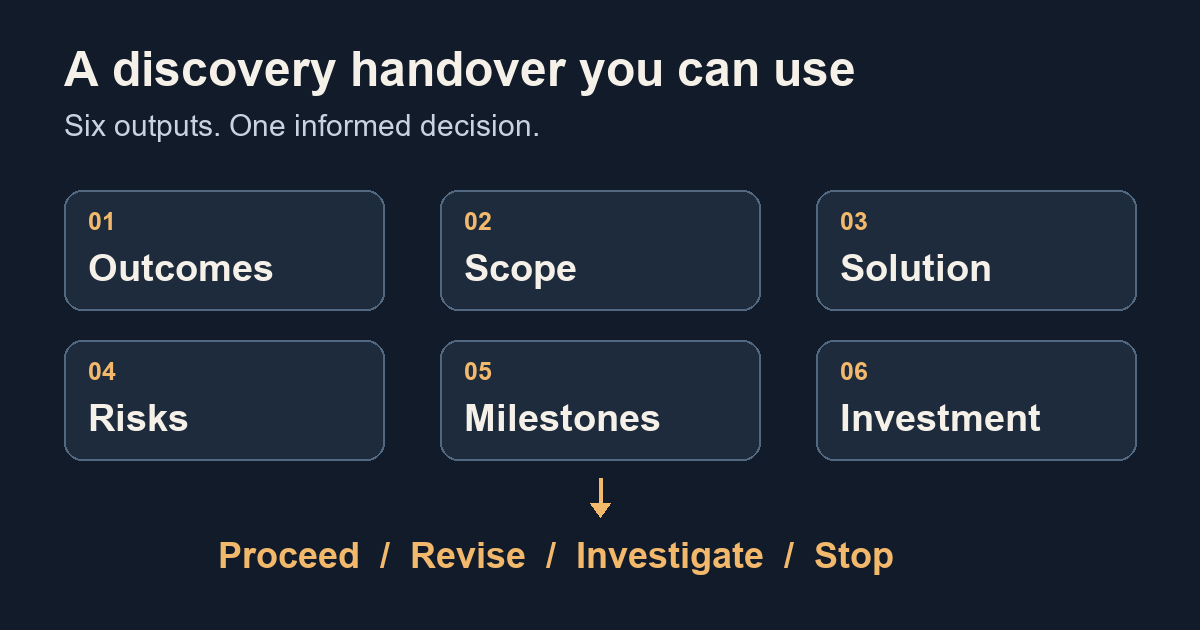
You have explained the problem, shared access to your systems and paid for discovery. At the handover, you need enough evidence to decide what happens next. Useful software discovery deliverables should help you choose whether to build, what to tackle first, which risks remain and what you are committing to.
This guide gives you a checklist for that decision. It follows the six outputs of our Product & System Blueprint, with a fictional order-processing example to show how the pieces fit together. Use it when reviewing a discovery proposal or preparing for the final walkthrough.
What decisions should software discovery deliverables support?
Start with the questions you expect to answer at the end. Is the problem worth addressing? Could configuration or an existing tool solve it? What would a first useful release include? What must be checked before anyone commits to a delivery date or price?
Discovery should leave a written record of what was learned from users and systems, what is proposed and what remains uncertain. A useful handover connects those findings to a recommendation you can question.
The GOV.UK Service Manual similarly frames discovery around understanding a problem and deciding whether further work is justified. Its public-service delivery phases differ from a commercial Blueprint; the relevant principle is to investigate before committing to implementation.
1. An outcome map tied to the work people do
An outcome map explains who has a problem, where it happens and how you will assess improvement. A request to “automate order management” needs more detail before it can guide a build.
For illustration, imagine a distributor whose customer-service team asks the warehouse for shipment updates before replying to buyers. The discovery record might identify the lookup process, the people involved, the records they consult and the delays they encounter.
The proposed outcome could be that customer service can answer routine shipment questions from an agreed order record. To evaluate that outcome, the team could measure time spent finding an answer and how often warehouse confirmation is still needed. Record a baseline before choosing a target; any improvement figure remains a hypothesis until measured.
- Ask to see: the current workflow, affected users, evidence behind the problem and proposed measures.
- Check: can the people doing the work recognise their actual process, including exceptions?
2. A prioritised backlog with boundaries
A backlog turns the problem into pieces of work and explains their order. It should make the first release understandable to a business owner, including what is deferred and what is excluded.
In the distributor example, showing shipment state may depend on agreeing order identifiers and the meaning of a partial dispatch. Those decisions come before a dashboard. Customer self-service might be a later phase, with its own access and support requirements.
For each proposed item, look for its purpose, priority, dependencies and a way to confirm it works. Keep unresolved questions visible. If the warehouse cannot yet provide a reliable shipment record, the plan should say how that uncertainty will be resolved before promising a live status screen.
- Ask to see: first-release scope, later work, exclusions and the reason for each priority.
- Check: can you remove or postpone an item and understand what that changes?
3. A solution outline that explains the choices
The solution outline describes how the proposed parts fit together: which existing tools stay, which records they own, where information moves and what new software is needed. The level of detail should support the next decision without implying that every implementation question has been settled.
For our fictional distributor, the outline might keep the accounting package, identify the warehouse record used for shipment status and propose a staff-only order view. It would explain how order references are matched and where a person handles missing or conflicting records.
Ask which alternatives were considered. A platform setting, existing app or process change may be enough. If custom development is recommended, the outline should explain the requirement those options cannot meet and the trade-off you are accepting.
- Ask to see: a readable system map, data ownership, proposed integrations and the reasons for the chosen approach.
- Check: can your technical lead or another delivery team follow the recommendation and identify its assumptions?
4. A risk register with a next action for each uncertainty
A risk register is useful when it changes what happens next. Each material risk needs a potential consequence, an assessment of likelihood and impact, an owner and a response.
Suppose the warehouse can export shipment records, but no one has checked whether the export includes partial dispatches. The risk is that the proposed order view gives customer service an incomplete answer. A useful response is to inspect representative records with warehouse staff before confirming the integration scope.
Separate a finding from an assumption. “A sample export includes shipment references” describes observed evidence. “Every shipment has a usable reference” requires broader checking. Naming the difference helps you decide which uncertainty can wait and which one blocks a commitment.
- Ask to see: the important risks, supporting evidence, responsible people and actions needed before the next decision.
- Check: does a dependency on your staff or another supplier have an owner who has agreed to act?
5. Delivery phases you can accept one at a time
A delivery plan sets out milestones, their dependencies and the evidence needed for acceptance. Dates need an explicit basis: access to systems, availability of the people reviewing the work and resolution of the risks that could change scope.
For example, an early milestone could show shipment information for an agreed set of representative orders. The walkthrough would include an unshipped order, a partial dispatch, a completed dispatch and a missing warehouse update. Someone responsible for operations should be able to confirm whether each result matches the agreed behaviour.
Write the expected behaviour for exceptions as carefully as the normal path. When shipment information is missing, the view should make that state clear and identify the next action. The exact behaviour belongs in the agreed acceptance criteria.
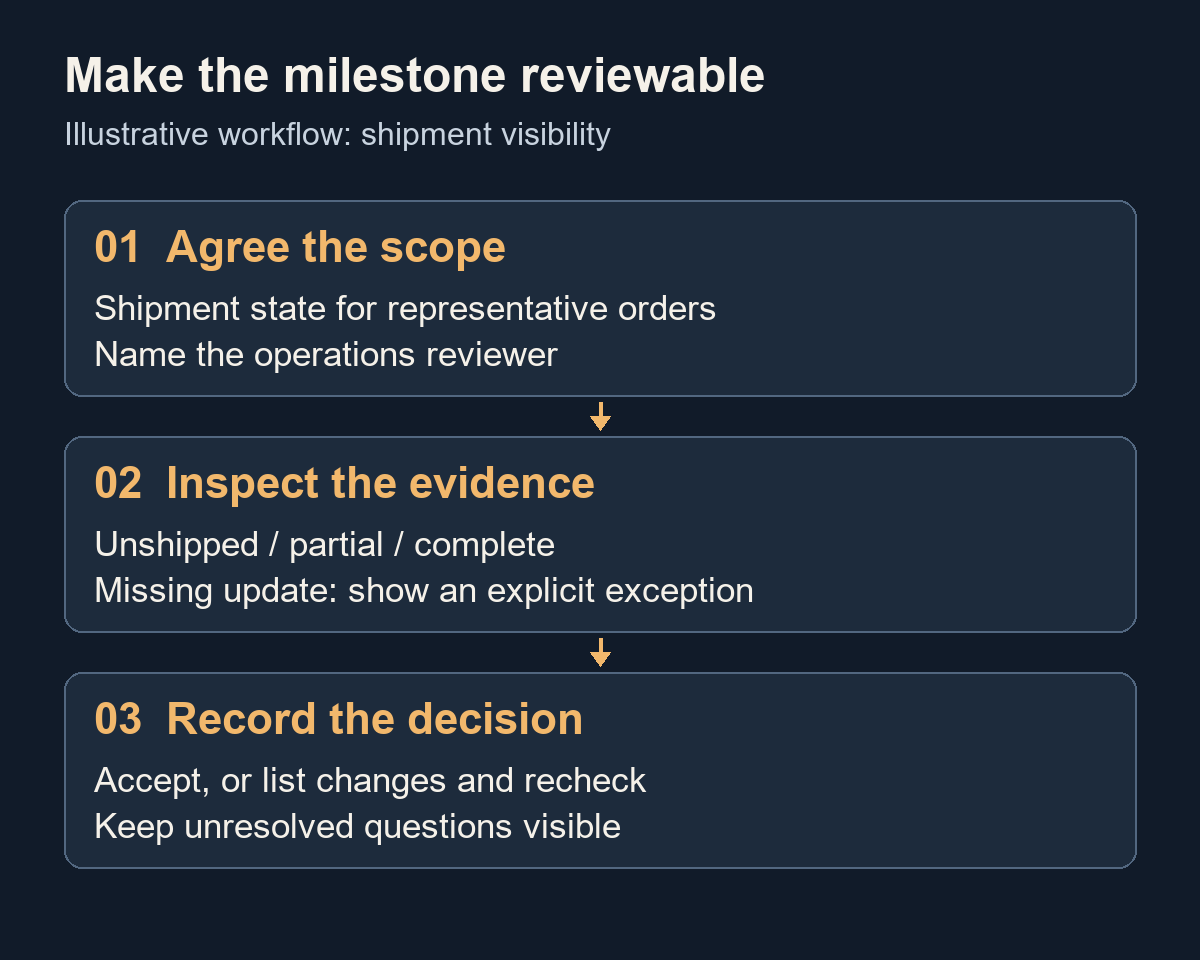
- Ask to see: milestone scope, dependencies, reviewer and acceptance criteria, including important failure cases.
- Check: can you describe what you will inspect at the demonstration and who can accept it?
6. An investment range with its assumptions attached
The investment range should follow from the scope, phases and risks you have just reviewed. Ask what it includes, what it excludes and which unresolved decisions could move it. Separate build work from recurring operating costs and any proposed ongoing support.
A range needs enough explanation for you to make a decision. If access to a supplier system is unconfirmed, ask how that affects the estimate and what finding would trigger a revision. A single reassuring number with hidden dependencies gives you little basis for comparing options.
In Phuongnamsoft’s engagement model, the Blueprint produces an investment range. A subsequent Build proposal sets the fixed price, scope, milestones and acceptance terms. The Blueprint fee is credited towards a Build only when the proposal explicitly says so.
- Ask to see: the estimate basis, included work, exclusions, dependencies and known operating costs.
- Check: do you know what must be resolved before the next commercial commitment?
Use this checklist in the handover meeting
Choose one important workflow and trace it through the whole package. The proposed outcome should explain a backlog item; that item should appear in the solution outline and a delivery phase; its risks and cost assumptions should be visible.
- Can we explain the problem, the evidence and the intended outcome in our own words?
- Can we identify the first useful release, its dependencies and what it leaves out?
- Do we understand why this approach was chosen over simpler alternatives?
- Does every material unresolved question have an owner and a next action?
- Can we inspect each milestone against written acceptance criteria?
- Can we connect the investment range to scope, risks and exclusions?
- Can we keep the documents and give another competent team enough context to assess the plan?
At handover, ask the team to record the decision: proceed, revise the scope, investigate a specific uncertainty or stop. Stopping can be a useful discovery outcome when the evidence does not justify the proposed investment.
Our Blueprint is a standalone paid engagement, usually one to two weeks, with outputs you keep. You can use them to plan a Build with us, take the plan to another team or decide to wait. Agree the deliverables and their level of detail in the proposal before starting, so the final review has a clear basis.
Start with a paid Blueprint, not a guess
One to two weeks to agree the scope, the risks and the measure of success — then a fixed price for the Build.